
New York — The delegation of the National Committee for the Administration of Gaza (NCAG), led by Chief Commissioner Dr. Ali Shaath and joined by Commissioner for Finance Dr. Bashir Al-Rayyes, concluded a series of high-level meetings and engagements on the sidelines of the 81st Session of the United Nations General Assembly (UNGA81) in New York. The discussions focused on early recovery and reconstruction priorities, restoration of essential services, resource mobilization, and building partnerships to support Gaza’s recovery efforts.
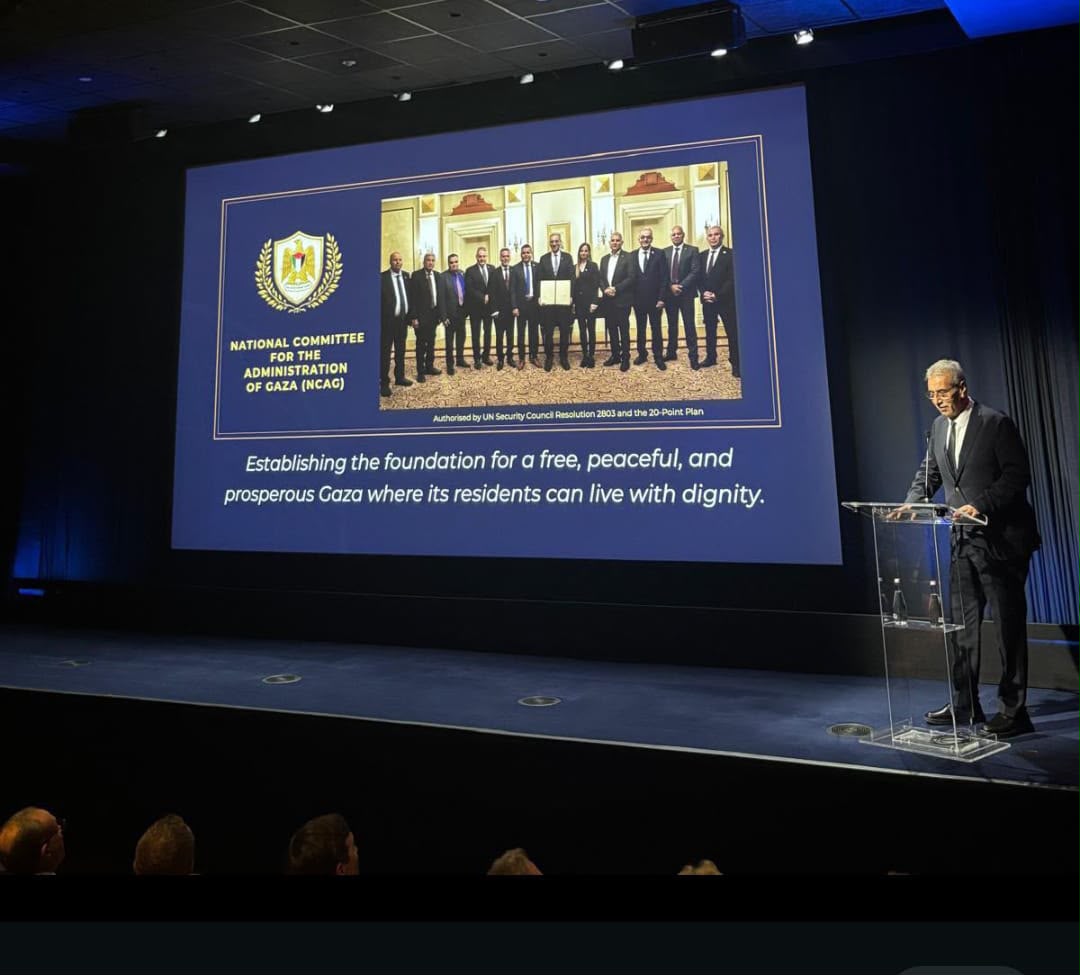
During the Board of Peace event on the implementation of the 20-Point Comprehensive Peace Plan for Gaza, Dr. Ali Shaath presented the 6-Month Gaza Recovery Program, which provides a practical roadmap for what can be delivered during the first phase of recovery. The version presented comprises 66 programs across six key clusters, with an estimated cost of approximately US$2.45 billion. The programs are ready to begin, subject to the availability of funding, access, and the necessary conditions for implementation. The program covers six clusters: infrastructure development, human development, economic acceleration, digital transformation, legal sector reform, and civil peace. It includes interventions to restore and rehabilitate housing, hospitals, roads, and water and electricity networks; manage debris and solid waste; restore municipal services; support education, healthcare and economic activity; and rebuild institutional and digital capacities.
Dr. Ali Shaath stressed that Gaza’s recovery must be Palestinian-led and pursued in genuine partnership with international stakeholders, grounded in Palestinian ownership, protection of rights, inclusion, transparency, and the ability to respond to evolving needs. This approach aims to ensure a gradual transition from emergency response toward the restoration of essential services and sustainable recovery.
The six-month program forms part of Gaza’s far broader recovery and reconstruction needs. The joint assessment by the European Union, United Nations and World Bank (RDNA) estimates these needs at approximately US$71.4 billion over the next decade, including US$26.3 billion during the first 18 months to restore essential services, rehabilitate critical infrastructure, and support economic recovery.
Throughout his engagements in New York, Dr. Shaath took part in a number of meetings on the sidelines of the General Assembly, addressing: One-Year After the New York Declaration; the 20-Point Comprehensive Peace Plan for Gaza; UN Security Council Resolution 2803; recovery and reconstruction; humanitarian access; and the strengthening of coordination and Palestinian ownership of recovery efforts.
The delegation also took part in the ministerial roundtable on Gaza early recovery, “From Sharm El-Sheikh to Phase II – Consolidating Peace and Early Recovery,” co-chaired by Egypt, Germany, France and the European Commission. Discussions focused on moving from planning to practical implementation, mobilizing resources, and strengthening coordination around a Palestinian-led recovery process.
As part of discussions on sectoral needs and implementation mechanisms, Dr. Shaath met with UN Under-Secretary-General and UNOPS Executive Director Jorge Moreira da Silva. He also took part in the Ad Hoc Liaison Committee (AHLC) Ministerial Meeting, which addressed urgent support for Palestinians, coordination of recovery and reconstruction efforts, and the strengthening of Palestinian ownership and institutional capacity.
In the context of moving from planning to implementation, Dr. Bashir Al-Rayyes took part in engagements related to the launch of the first two projects under the European Union-led Team Gaza initiative, with a combined value of €43 million, aimed at restoring water services and solid waste management in Gaza. The projects are being implemented in cooperation with UNICEF and UNDP. Of the total funding, €37 million has been allocated to improving access to drinking water and reducing exposure to wastewater for approximately one million people, while €6 million has been allocated to support waste collection and transportation and to implement a recycling pilot project.
The NCAG affirms that its participation in the New York meetings forms part of its efforts to move recovery priorities from planning into practical, implementable programs. It remains committed to building effective partnerships with international institutions and mobilizing the resources needed to restore essential services and improve living conditions — toward a sustainable, Palestinian-led recovery and reconstruction process that responds to the actual needs of the people of Gaza.